The Art & Its Story · Updated June 2026

The History of Flamenco — From Andalusia to the World

Three centuries, four cultures and one unmistakable sound. Here's where flamenco came from, how it grew, and why Seville sits at its heart.

The history of flamenco begins in 18th-century Andalusia, where Roma, Moorish, Jewish and Spanish traditions fused into song, dance and guitar — professionalised in Seville's cafés, renewed in the 20th century, and named UNESCO heritage in 2010.

The history of flamenco Editorial banner reading The Story of Flamenco, from Andalusia to the world, with a guitar motif. ANDALUSIA · SINCE THE 18TH CENTURY The Story of Flamenco Four cultures, three centuries, one unmistakable sound.

Key Takeaways

  • Flamenco took shape in 18th-century Andalusia from a blend of Roma, Moorish, Jewish and Spanish traditions.
  • Its three elements are cante (song), baile (dance) and toque (guitar), bound by handclaps (palmas).
  • The cafés cantantes (c.1860–1920) made it a professional, public art — with Seville at the centre.
  • Paco de Lucía and Camarón de la Isla reinvented it in the 1970s, fusing jazz, rock and Latin music.
  • UNESCO named flamenco Intangible Cultural Heritage of Humanity in 2010.
  • Seville — and its Triana quarter — is one of its cradles and the home of the tablao.

What is flamenco?

Flamenco is an Andalusian art of song, dance and guitar — not a single style but a whole tradition, recognised by UNESCO as a living heritage of humanity. At its core is raw emotion: the singer (cantaor or cantaora) pours out tales of love, loss, pride and grief, the dancer answers with thunderous footwork and sculpted arms, and the guitarist holds it all in rhythm. Handclaps (palmas) and shouts of encouragement (jaleo) bind the three together into a conversation that's half-composed, half-improvised.

It isn't a museum piece. Flamenco is still evolving on stages from Seville's tablaos to concert halls worldwide. But to understand why it moves people the way it does, you have to know where it came from.
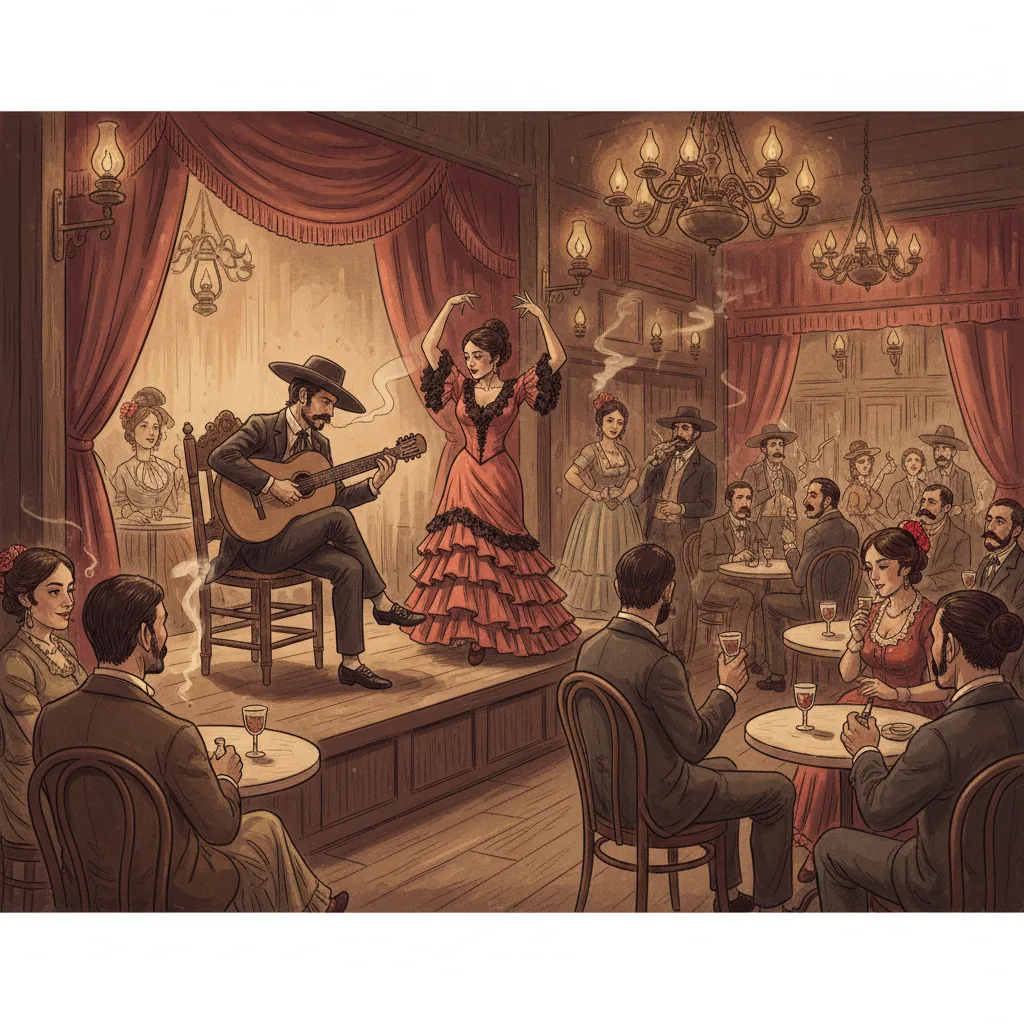
A 19th-century Andalusian café cantante scene with a flamenco guitarist and dancer performing by lamplight
A 19th-century café cantante — the smoky Andalusian cafés where flamenco first became a public, professional art.

Where did flamenco come from?

Flamenco was born in Andalusia, in southern Spain, from centuries of cultural mingling. When Roma (Gitano) communities arrived in the 15th century, they met a region already rich in Arab-Andalusian, Sephardic Jewish and local Spanish folk music. Out of that fusion — in homes, fields and village gatherings, as a way to voice pain, love, pride and protest — flamenco slowly took form. By the 18th century it had become recognisable, its songs grouped into styles, and the Spanish guitar woven in as accompaniment.

Its cradle is often described as a triangle: Seville (and its Triana quarter), Jerez de la Frontera and Cádiz. Even the word "flamenco" is contested — some trace it to the Spanish for "Flemish" (a 16th-century nickname suggesting boldness and swagger), others to the Arabic felah-mengu, "wandering peasant," a nod to the nomadic Gitano life. The debate itself reflects flamenco's tangled, many-rooted origins.

Timeline

How did flamenco develop over time?

A timeline of flamenco history 18th century: origins, fusion of Roma, Moorish, Jewish and Andalusian traditions. 1860 to 1920: the cafés cantantes professionalise flamenco in Seville. 1920s to 1950s: opera flamenca takes it to theaters. 1950s to 1960s: tablaos and peñas. 1970s: nuevo flamenco with Paco de Lucia and Camaron. 2010: UNESCO Intangible Cultural Heritage. Six Eras of Flamenco 18th c. Origins A fusion is born Roma, Moorish, Jewish & Andalusian traditions blend in Andalusia 1860–1920 Golden Age The cafés cantantes Flamenco goes professional and public in Seville, Cádiz & Málaga 1920s–50s On stage Opera flamenca Theaters and bigger audiences — and a purist backlash 1950s–60s Venues Tablaos & peñas Dedicated tablao venues open; peña clubs safeguard the pure art 1970s Renewal Nuevo flamenco Paco de Lucía & Camarón fuse jazz, rock and Latin music 2010 Recognition UNESCO heritage Inscribed as Intangible Cultural Heritage of Humanity
From 18th-century gatherings to global heritage — the six eras that shaped flamenco as we know it.

The turning point was the café cantante. In the second half of the 19th century, flamenco moved out of private patios and into Andalusia's cafés, where paying audiences and professional performers sharpened the art. The singer Silverio Franconetti (1831–1889) opened a celebrated flamenco café in Seville in 1881 — a competitive stage where the modern tradition was forged.

The Anatomy

What are the three elements of flamenco?

The three elements of flamenco Cante, the song, the emotional core sung by a cantaor or cantaora. Baile, the dance, percussive footwork and expressive arms. Toque, the guitar that holds the rhythm. The Three Elements CANTEthe songThe emotional core,sung by a cantaoror cantaora — love,loss, pride, grief. BAILEthe dancePercussive footwork(zapateado) andsculpted arms —passion made visible. TOQUEthe guitarThe Spanish guitarthat holds the rhythm(compás) and answersthe voice.
Cante, baile and toque — bound by handclaps (palmas) and shouts of jaleo into a single, living conversation.

Each piece of flamenco belongs to a palo — a style with its own rhythm and mood. They run from the deep, grief-soaked cante jondo of the soleá and seguiriya to the joyous snap of a bulería or alegría, with the fandango and tango families in between. There are dozens in all — which is why no two flamenco nights feel quite the same.

Who shaped flamenco's history?

A handful of artists changed the art for good. Silverio Franconetti (1831–1889) is often called the greatest singer of the 19th century and the man who shaped the café cantante tradition in Seville. La Niña de los Peines (Pastora Pavón) became one of the most revered cantaoras of the early 20th century, expanding the range of the cante itself.

Then came the revolution. Guitarist Paco de Lucía (1947–2014) brought jazz harmony, Latin rhythm and classical technique to flamenco — and introduced the Peruvian cajón with his 1973 album Fuente y Caudal, now a fixture of any modern show. His friend and collaborator, the singer Camarón de la Isla (1950–1992), electrified a generation; his 1979 album La Leyenda del Tiempo scandalised purists and won flamenco a vast new audience. Between them, they proved the tradition could change without losing its soul.

Why is Seville central to flamenco's history?

If flamenco has a capital, it's Seville. The city and its Gitano quarter of Triana are among the art's cradles; the cafés cantantes flourished here; and the professional tablao tradition was effectively born in the city. That history is why Seville still has the deepest concentration of quality shows anywhere — and why it's where so many people see flamenco live for the first time. When you're ready to turn the history into an evening, start with our ranking of the best shows, browse every venue, sort out what to wear or going with kids, or weigh up Seville versus Granada.

How we put this together: we drew on UNESCO's heritage listing and established flamenco histories (including Andalusia's regional cultural archives and encyclopaedic sources), cross-checking dates and figures, to summarise three centuries of a still-living art in June 2026. Flamenco's origins are debated by scholars; where the record is contested, we've said so.
Rafa Giménez
Triana-born writer who has reviewed flamenco tablaos and peñas across Andalusia for over a decade.
Last updated: June 2026

Questions

History of Flamenco — FAQ

What is the history of flamenco?+
Flamenco emerged in 18th-century Andalusia from the blending of Roma, Moorish, Jewish and Spanish folk traditions. It moved into the 19th-century cafés cantantes, was professionalised on stage in the 20th century, renewed by Paco de Lucía and Camarón in the 1970s, and named UNESCO Intangible Cultural Heritage in 2010.
Where did flamenco originate?+
In Andalusia, southern Spain — especially the triangle of Seville (with its Triana quarter), Jerez de la Frontera and Cádiz. It grew from the Roma communities who arrived in the 15th century, fused with the Arab-Andalusian, Jewish and local folk music already there, taking shape in the 18th century.
What are the three elements of flamenco?+
Cante (song), baile (dance) and toque (guitar). Cante is the emotional core; baile is built on percussive footwork (zapateado) and expressive arms; toque is the guitar that holds the rhythm. Handclaps (palmas) and shouts (jaleo) bind them.
What are palos in flamenco?+
Palos are the styles of flamenco, each with its own rhythm and mood — from the deep, sorrowful cante jondo (soleá, seguiriya) to festive forms (bulería, alegría), with the fandango and tango families in between. There are dozens in total.
Who are the most important figures in flamenco history?+
Silverio Franconetti (1831–1889) shaped the café cantante era in Seville; La Niña de los Peines was a towering early cantaora. In the modern era, guitarist Paco de Lucía (1947–2014) and singer Camarón de la Isla (1950–1992) transformed flamenco by fusing it with jazz, rock and Latin music.
Why is Seville important to flamenco?+
Seville and its Gitano quarter of Triana are among flamenco's cradles and the home of the professional tablao. The cafés cantantes flourished here, and the city still has the deepest concentration of quality shows — which is why many visitors see flamenco here first.

See the History Come Alive

Three centuries of flamenco, performed nightly in Seville. Compare every show — free cancellation up to 24 hours before.

Find Your Flamenco Show →